Ever have one of those days when your equipment gives out at the wrong time? I did, last night. Being a person who likes to have everything set up and equipment tested, connected and working, I always start early to set up my portable classroom in the library. I use a SMARTboard and a digital projector and laptop on a cart. I had the space set up and was testing the equipment when I heard "Zzzzzzzztttttt" when I turned on the digital projector and no light appeared. I looked for a new bulb, presuming that to be the problem, but could not locate one immediately. A call to my assistant at home finally located it. The instructor came in at the right moment and I determined that we could move the class to my other teaching classroom which doesn't hold as many students. My evening assistant was able to get the computer hooked up while I transferred everything and everyone downstairs.
The good news is that in spite of the delay, I started only about 5 minutes late. The bad news is that it looks like I need a new digital projector and not just a bulb. (This is where it is good to have a great relationship with IT so they will lend me a projector to use for awhile)
This situation is one that I don't relish as an instructor; I like to be prepared and ready to go. Fortunately, I was able to stay relatively calm and not stress too much. "Accept what you cannot change." I tried to remember that. Good thing I had a spare room to use; it would have been a very short class, otherwise. Life throws you lemons all the time; I'm glad I was able to make lemonade this time.
Showing posts with label Campus technology. Show all posts
Showing posts with label Campus technology. Show all posts
Friday, September 26, 2008
Tuesday, May 06, 2008
EduComm 2008

EduComm Conference 2008 at InfoComm
June 18-20, 2008
Las Vegas Hilton Convention Center, Las Vegas
When it comes to ensuring that higher education institutions are taking advantage of the latest technologies to delivery instruction and manage facilities, individuals attending the EduComm Conference are ahead of the game. From smart classrooms to lecture capture systems to distance learning, EduComm at InfoComm provides administrators with the latest insights into modern technologies and their implementation within higher education.
Keynote speakers David Pogue, New York Times personal technology columnist, and Gary Kayye, founder of rAVe Publications and chief visionary at Kayye Consulting, will entertain as they share a vision for excellence in higher education.
For more information, contact:
Kathleen Pomorski
Senior Account Executive
KEH Communications
504 Baltimore-Annapolis Boulevard
Suite 6
Severna Park, MD 21146
kathleen@kehcomm.com
Tags: EduComm 2008, EduComm Conference, Educational technology
Sunday, August 19, 2007
What's in a name?
What's in a name? Or, for that matter, a password? Well, it can mean getting access to your computer, your bank account, your e-mail or even your own blog. I have more usernames and passwords than I can remember and the older I get, the less I can remember them. If a tool does not require you to have one, then your IT Department certainly will.
Today, increasing security risks mean that you are likely to have to submit to a more complicated sign-in process to gain access to your work computer and your employer's networks. A university network is highly desirable and many are taking steps to better protect them. I do not blame them; it is frustrating and scary when you discover that someone has "invaded" you.
Now I have to admit, I do not always follow suggestions not to use familiar words and numbers to create a password. And yes, I do use the same password more than once and even write them down sometimes. If I didn't, I would constantly be hitting the forgot password link on every system I was trying to access, like this one, since I couldn't remember what I used for a password to post to the blog!
It is unfortunate that there are people who wish to do nothing more than to create electronic havoc wherever they can and as often as they can. As an administrator, I understand the necessary evils of having to log into my various accounts and networks to protect the information they contain. As a librarian, I wish that we could all freely access information without worrying about someone doing unethical things with it. Technology has given libraries incredible ways to share knowledge and librarians are eager to use as many as possible, if only it can be made easier to do so.
But even if it is tedious to always have to "log-in," there is a bright spot to it all-- my vocabulary skills get a rigorous workout as I try to create that perfect username and password combo that I will least likely to forget.
Monday, May 07, 2007
I am an "Omnivore"
Catching up on my bloglines account this afternoon I found yet another interesting post from Walt at Random; Lackluster veteran: Bias, much? concerning a Pew Internet report that includes a quiz that promises to help me determine what kind of information technology user I am. Since I am a technology sucker for this type of online quiz, I recently took a blogthings quiz and found out I am a chocolate cake, I did answer the questions honestly. Of course, since I could continue to take the quiz as often as I wanted, making it easy to manipulate the results, it does give one pause.
The quiz in question is called an Internet Typology Quiz and was introduced accordingly:
I guess it could be said in true Omnivore fashion I took the quiz, posted the results here, blogged about it for all asunder, and provided links for anyone else who may be interested.
But I still don't particularly like cell phones.
Tags: Pew Internet, Interent Typology Quiz, Blogthings
The quiz in question is called an Internet Typology Quiz and was introduced accordingly:
My quiz results suggest I am most closely related to an "Omnivore." That's all well and good, but since the basic "who are they" umbrella definition of the Omnivore category suggests I am young (uh-huh), ethnically diverse (no), male (no again), and should have a median age of 28 (smiles only), I beg to differ. I do find it interesting that 42% of people in this category are students. Working with students in the IRC on a daily basis I spend a lot of time with their technology questions as well. To be fair, the results came back with a disclaimer that while I closely resemble an Omnivore, "this does not mean that you (I) necessarily fit every group characteristic." While I do have a digital camera and have watched TV online, it did not take into account my intense dislike of cell phones (but I do have and use one)."Do you cringe when your cell phone rings? Do you suffer from withdrawal when you can't check your Blackberry? Do you rush to post your vacation video to your Web site? The questions below allow you to place yourself in one of the categories in the Pew Internet Project's Typology of Information and Communication Technology Users. To identify the typology group to which you belong, please answer the questions below. When you press the 'Calculate MyResults' button, a new page will tell you in which group you fit, along with a description of the general characteristics of that group." (Pew/Internet, 5/7/07)
I guess it could be said in true Omnivore fashion I took the quiz, posted the results here, blogged about it for all asunder, and provided links for anyone else who may be interested.
But I still don't particularly like cell phones.
Tags: Pew Internet, Interent Typology Quiz, Blogthings
Wednesday, December 13, 2006
BARN's and ASRS
This morning I have been perusing the growing stack of journals on my desk, passing on one's I have read to other librarians and putting others aside for further reading. In addition to general library fare that includes Booklist, Book Links, and Library Journal, I began browsing through the year end special issue of Campus Technology that features "101 Best Practices in ... Smart Classrooms, Connectivity, and Administrative IT," December 2006. Paying particular interest to this issue because recently I began serving on a technology instructor search committee for the College of Education, I was intrigued to find buried amongst emerging classroom technologies (check out Tegrity) a Smart Library at Utah State University with the Smart Classroom section.

Unfortunately, the article made no further mention regarding exactly what books were housed within the USU Merrill-Cazier Library retrieval system, the BARN. Sharing my finding with two student workers, I wondered if it was the entire library or specific collections within the library utilizing the system. In all honesty, we were a bit taken aback by the idea of a juvenile collection being part of this storage since it is routinely a frequently browsed area in our library. I was intrigued enough to want to learn more. They were concerned I watched the availabe web cam to see how it worked. Check out the BARN (ASRS) page on the USU Merrill-Cazier library web site to learn about what the BARN is, why they chose a BARN, and what is housed in their BARN. For anyone wondering what BARN stands for, it means Borrower's Automated Retrieval Network; a much simpler, catchier acronym than ASRS or Automated Storage and Retrieval System.
"Utah State University’s new Merrill-Cazier Library, opened in the 2005-2006 academic year, is using technology to not only retrieve information from the library catalog, but also retrieve the books themselves. The $42 million project features a state-of-the-art system of robotic stacks, 85 feet high, 60 feet wide, and 120 feet long, which locates requested materials among the 1.5 million volumes and speeds them to patrons—at a rate of 328 feet per minute. The space-saving system allows for many years of collection development. Says Linda Wolcott, vice provost for libraries, “The Merrill-Cazier Library has become the hub of learning on campus, providing the resources, access to technology, and flexible study environments that support the way students learn today.” " (Smart Library, Campus Technology, 12/2006)
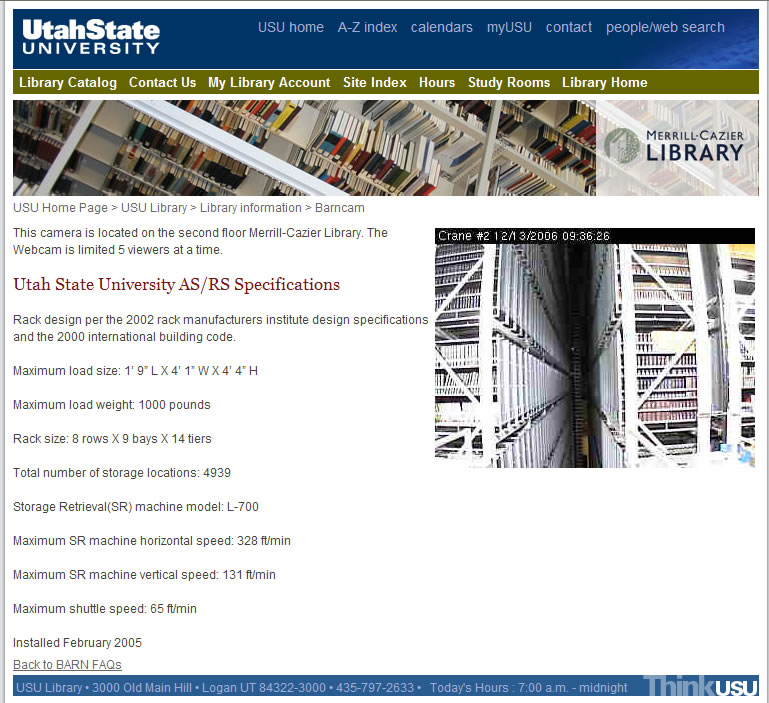
Unfortunately, the article made no further mention regarding exactly what books were housed within the USU Merrill-Cazier Library retrieval system, the BARN. Sharing my finding with two student workers, I wondered if it was the entire library or specific collections within the library utilizing the system. In all honesty, we were a bit taken aback by the idea of a juvenile collection being part of this storage since it is routinely a frequently browsed area in our library. I was intrigued enough to want to learn more. They were concerned I watched the availabe web cam to see how it worked. Check out the BARN (ASRS) page on the USU Merrill-Cazier library web site to learn about what the BARN is, why they chose a BARN, and what is housed in their BARN. For anyone wondering what BARN stands for, it means Borrower's Automated Retrieval Network; a much simpler, catchier acronym than ASRS or Automated Storage and Retrieval System.
With what may be a growing trend, how many institutions can actually afford this technology? I would imagine it is not something smaller and/or mid-sized academic libraries will quickly adopt. Not just because of the cost issue, but also because collections may not warrant off-site storage of any type. Either way, it sheds an interesting light on the shelf shifting I have been doing in the library juvenile collection for the last 4 - 6 weeks. Creating additional room where no room exists is an ongoing challenge, even an opportunity. In retrospect, a nice little robotic arm would have been welcomed.
Here are a few academic libraries in Canada and the US utilizing ASRS:
- University of British Columbia
- Eastern Michigan University
- Sonoma State University
- Oxford University Gazette
Tags: ASRS, Automated storage and retrieval systems, Academic libraries and ASRS, Utah State University, USU Merrill-Cazier Library, Campus Technology
Subscribe to:
Posts (Atom)