Showing posts with label Collection development. Show all posts

Tuesday, September 21, 2010

Collection presentation & adjustment

Most of last year, and the bulk of this summer, was spent planning, purchasing, and processing collection items for the new IRC at the AU Columbus Center. The beginning of September brought an 'official' space planning visit; time was spent arranging furniture and the collection. Determining what should go where is fraught with challenge. For me, the IRC has always been a more fluid area. With the exception of this summer, I have moved one collection or another on the second floor to make things 'fit better' and be more useful and accessible for patrons. Therefore, one of the last things I said to the GA helping me was, live with it for a few months (this term). We can always move things around later.

Truer words ... After ordering media bags for the big books in Columbus, I developed display envy and determined to find a better way to present the main campus collection. Several days' research into library shelving led me to Library Design Association, they sent sample media rack bars from MJ Industries and Estey. I was able to test them in our stacks; one was perfect for audio books and the other for big books.


Last Friday the bars arrived, Monday I began the task of putting each of the big books into a hanging bag (it took significantly longer than anticipated) and organizing the collection. It looks wonderful! The bags hang spine out so labels on the top and bottom left corner are easily visible; the collection is presented in LC order. There is adequate room for users to browse the collection without having to pull big books from the cart.

This move has an added benefit, the adjacent collection is audio books and several of the big books have corresponding audio elements available. Placing the collection in LC order revealed a few holes, it would benefit to have a few more basic fiction and Spanish language titles (though I probably will need to purchase two more racks to facilitate the weight of these purchases). Signage is in place, the collection is ready for use, and notices were posted on the IRC news blog and scheduled to post on the library news blog later this week. The best thing? Students required to use big books in one of the children's literature classes have already commented happily on the change.

Friday, December 11, 2009

Kirkus Reviews & Another Who's Who

From my email inbox this morning, the end of a journal ...

"As part of the sale of its business to business publications, Nielsen Business Media has announced that it is closing its book review publication Kirkus Reviews as well as Editor & Publisher." - Library Journal, 12/10/09

... and a new Who's Who directory non-affiliation notification from Emerald Group Publishing.
"Please be aware that a company called Emerald Who's Who is contacting management professionals and academics around the world asking them to become a member of their Who's Who directory (Emerald Who's Who for Executives and Professionals). Emerald Group Publishing Limited is in no way affiliated with this company and does not endorse it in any way." - Mark Hindwell, External Relations, Emerald Group Publishing Limited, 12/11/09

Saturday, September 22, 2007

Borrowing library books

Amongst my various Bloglines feeds on Wednesday afternoon was a new Read Roger post; Throw the book at her? In it were links to an incident concerning a Lewiston, Maine library patron who decided the content and illustrations of a children's book inappropriate, has checked them out of the library, and refuses to return them.

From the Associated Press
Boston Sun Journal

Critic of sex education book refuses to return library copies
September 18, 2007

LEWISTON, Maine --A Lewiston woman who was upset by the content of an acclaimed sex education book published 14 years ago has checked out copies from two libraries and refuses to give them back.

"Since I have been sufficiently horrified of the illustrations and the sexually graphic, amoral abnormal contents, I will not be returning the books," JoAn Karkos wrote the Lewiston and Auburn public libraries last month.

Each letter was accompanied by a check for $20.95 to cover the cost of the book, "It's Perfectly Normal: Changing Bodies, Growing Up, Sex & Sexual Health."

"This has never happened before," said Rick Speer, director of the Lewiston Public Library. "It is clearly theft."

Speer returned the check, along with a form Karkos could use to request that the book be removed from library shelves. But he said he may seek help from police if she doesn't return what she borrowed.

"That's really what we want," Speer said. "We want the book back."

Written by Robie H. Harris and illustrated by Michael Emberley, the book features frank but cartoon-like illustrations of naked people in chapters on topics that include abstinence, masturbation and sexually transmitted diseases.

The publisher, Massachusetts-based Candlewick Press, said "It's Perfectly Normal" has been sold in 25 countries and translated into 21 languages.

Championed by Planned Parenthood, the book has come under fire from conservative groups such as Concerned Women for America and the anti-abortion American Life League. It was the American Library Association's most challenged book in 2005, topping a list that also included books by J.D. Salinger, Toni Morrison and Judy Blume.

Karkos, 64, said in an interview Tuesday that she first heard of the book from the American Life League, an anti-abortion group. She felt compelled to act after she checked out the book and found it to be "pornographic" and worse than she originally feared.

"Hopefully, this will harness enough people to be sufficiently horrified and and want to speak out, to say it's gone too far," Karkos said, adding that she was aware that drawing attention to the book might raise people's interest in it.

Rosemary Waltos, director of the Auburn Public Library, said Karkos' decision not to return the book was "an inappropriate act" that will likely prove fruitless.

"If somebody wants a copy, they can get one," she said, noting that at least three dozen Maine libraries have copies available for interlibrary loan.

Both libraries have ordered replacements for the books Karkos took. Speers ordered two more copies because of an increase in requests for the book after the (Lewiston) Sun Journal published a letter from Karkos condemning the book.


There has been a subsequent flurry of interest regarding this issue, especially happening this close to ALA's yearly celebration Banned Books Week. Here are a few links to more information:

Comments on the news articles and blogs range from "how dare she" to "bravo." I found a statement on the Boston Daily Blog from a LIS student particularly well done:

"Not everyone will like what is selected for a library — not even librarians at times — but it is important that the materials selected present ideas and views in every area (liberal, conservative, radical, etc.) and should be, at the very least, unbiased. Librarians take extra means to selecting material and analyze how the materials will be used. They understand that some books may cause an uproar and they are trained to know how to handle those type of situations. It is not up to a library patron or a librarian on selecting books, it is rather on the basis on meeting the needs of the public." LIS Student, Comments, Boston Daily Blog


This student is right; librarians are trained to select books for their library and library patrons. Not everyone will agree with the selections, therefore policy is in place to process this through legal channels; recourse on what may be perceived to be objectionable material is available to every patron.

Books are not selected for collections without thought to readership, usability, function, and information. Librarians take pride in their collections and the development thereof. Case in point, each year when a children's literature professor brings his class to the IRC he mentions that prior to my arrival, the collection was seen as somewhat stagnant and did not fulfill needs for his class. As a result, he did not bring them to the library. Size and breadth of the collection before my arrival was contingent upon a small budget for children's literature; there were many quality titles in the collection. A budget increase allowed for considerable growth and ability to purchase curriculum supporting children's literature. I take pride in knowing "my" collection is growing and meeting the needs of library patrons.

Curiosity compelled me to see if AU library had It's Perfectly Normal as part of the juvenile circulating collection. We do not. However, OhioLINK has 20 libraries with the original 1994 publication, and six libraries with the 2004 ten year anniversary edition. Both public and academic libraries have copies in their collection; interestingly, various public library copies were checked out and several academic libraries had their copies tagged local use only. The book is particularly well represented in larger academic libraries, public libraries, and academic libraries with curriculum materials centers. If interested, Amazon and Barnes & Noble.com have the book and both have reviews from Publishers Weekly and School Library Journal.

Wrapping this up with a neat bow is the upcoming celebration of ALA's Banned Books Week, this year taking place September 29 - October 6. One of the most frequently challenged books in 2005? Robie H. Harris's title It's Perfectly Normal.

Have you read a challenged book lately?

Tags: , ,

Wednesday, July 25, 2007

Learn something new ...

Library inventory has made its way, along with the technical services assistant responsible for completing the process, to the juvenile collection. Working through the collection triplicates are considered for removal (weeding), spine labels are replaced, missing items are sometimes located, and an occasional book catches her attention which she, in turn, often brings to my attention. For both of us, yesterday was an instance of the latter in the form of Bang, Bang You’re Dead (1969) by Louise Fitzhugh and Sandra Scoppettone (photo c. 1969).

In Bang, Bang, You’re Dead, James and his friends, dressed as Cowboys and Indians and outfitted with toy guys, decide to play war. In the gleeful manner of young boys, a fight to the death ensues and concludes in a celebratory manner with ice cream for everyone. One day a second group of children lays claim to their hill and an ownership fight ensues, only this time it is with fists and blood and injury. The ultimate question of winning is voiced and met with James realization that “Nobody won.” Fitzhugh’s pencil illustrations present an oddly multicultural group for the time period and she does not minimize the violence depicted by their war. In the end, a quiet and appropriate moral of getting along is addressed when the boys decide to play war together, tomorrow.

A bit disconcerted with the graphic violence and unseemly topic portrayed, further investigation was warranted and revealed both a copyright date of 1969 and a date due slip last used in 1986. Asked if it should be removed from our collection, I determined it had intrinsic value for studying social issues in children’s literature and said no. Why? Thirty-eight years ago children playing war was commonplace, as were toy guns and stereotypical instances of Cowboys and Indians. The underlying theme of peace and “playing together” during the Vietnam War makes it historically and culturally significant from a juvenile literature standpoint.

I did a bit of Internet research this morning on Louise Fitzhugh and while a children’s literature scholar would be shaking their head at my lack of knowledge and naiveté, I found what I was looking for – in spades. Amongst other things, Fitzhugh is the author of Harriet the Spy and well known for her social commentary, writing, and illustrations during the 1960’s and 1970’s. Among the interesting information I found is a review of Bang, Bang, You’re Dead, from Time Magazine, July 13, 1969 (scroll down), posted on the Time/CNN website:


“BANG BANG YOU'RE DEAD, by Louise Fitzhugh and Sandra Scoppettone, illustrated by Louise Fitzhugh (Harper & Row; $3.95). Four scruffy kids playing "army" on a hill learn more about war than they bargained for when the rules change and fighting becomes real. A cheerful book despite its moral.” (Time, 7/25/07)


Internet Resources:

Tags: , , , , ,

Wednesday, February 21, 2007

And it continues ....

The controversy regarding Newbery Award winner The Higher Power of Lucky continues. Today I read two more blog postings on the topic; one from Keir Graff at Booklist Online and another from Neil Gaiman's blog. Both are interesting and present a new point of view.

"I've decided that librarians who would decline to have a Newbery book in their libraries because they don't like the word scrotum are probably not real librarians (whom I still love unconditionally). I think they're rogue librarians who have gone over to the dark side." (Gaiman, 2/20/07)"

"This kind of stuff — censorship spurred by the use of a clinically appropriate word – just makes me want to crawl under my bed and stay there until our country grows up. It’s not surprising that other nations are confused by our behavior when we consider ourselves grown-up enough to wage war and yet are too terrified to discuss certain parts of our bodies just because they happen to normally be hidden by underwear." (Graff, 2/21/07)


Is continuing to discuss the issue only creating more furor? This is blog is not what anyone would call an "A-list" library blog, so I doubt I am causing much of a ripple in the blogosphere, but isn't it time to let sleeping dogs lie?

Clarification (2/26/07):

My question was placed a bit too close to the conclusion of the quotes and may have caused confusion (my bad). Both of the aforementioned blog posts present valid arguments and comments on the current controversy regarding the Newbery Award winner. And obviously I am not against adding my two cents into the fray because I have posted on this topic twice since asking if it was time to stop the discussion about the word and concentrate on the book and it's overall contribution as a Newbery winner.


Tags: , , , ,

Monday, February 19, 2007

I would be remiss not to mention

Though not a children's librarian, in addition to running the IRC, I am the education liaison and lucky enough to be charged with juvenile collection development. Selecting children's books, including YA titles, is definitely a job perk. Like many children's librarians, it was with some interest I awaited the announcement of this year's Newbery and Caldecott awards at ALA's Mid-Winter meetings in Seattle last month. Curiosity is a big part of the wait, as well as the intrinsic challenge presented by hoping the chosen title is already part of the existing collection. It is a hit or miss process and while my performance of late with Newbery books has been good; my Caldecott record has been less than stellar. That is until this year when for the first time in ages the Newbery book was not already part of the juvenile collection. We have a small library endowment for children's books and each year when awards are announced the librarian in charge of the funds orders what we need. Translated, we get two copies of the Newbery and Caldecott award winners; one copy goes into the regular juvenile collection and the second into the Newbery and Caldecott specific sections leading off the juvenile collection.

Last Thursday the latest edition of Children's Bookshelf; "a free weekly newsletter from Publishers Weekly about all aspects of children's and YA publishing," arrived via email. In it there was a link to an article by Shannon Maughan at the Children's Bookshelf titled Listservs Buzzing over Newbery Winner:

"What's in a word? Plenty of controversy, if it happens to be a word naming a part of the male anatomy, and if it appears in a Newbery Award-winning novel. In recent weeks the online blogosphere inhabited by children's book professionals has been abuzz with debate over author Susan Patron's use of the word "scrotum" in her freshly minted Newbery winner, The Higher Power of Lucky. Librarians, teachers, reviewers and others have used blogs and listservs as forums to object to or defend the book and the ALA's selection of the title for one of its highest honors. (Children's Bookshelf, 2/15/07)"

Without reading the book, I have obviously been hesitant to comment on the growing controversy. As luck would have it, our copies arrived Thursday and I took home one of them to read over the weekend. Last night, I finished reading The Higher Power of Lucky and am more curious than concerned regarding the uproar. The book features Lucky, a ten-year-old girl. Yes, children reading this book are going to be third, fourth and maybe fifth graders. More importantly, I realize the vocabulary in question, used in several instances, may be off-putting for book talks by librarians in school libraries. I do not want to sugar coat the very real issue possibly faced with having the title in school libraries. However, this book is about more than a single word; one that, I might add, is simply defined at the end of the book without unnecessary embellishment.

I find it interesting that several other topics dealt with in Lucky are not mentioned in the debate. For instance, there is discussion of Alcoholics Anonymous, Gamblers Anonymous, parental death, and another character's mother in jail for selling drugs. Each of these topics is potentially troubling for in-school discussion as well, but what I keep reading about is the use of one word. Higher Power of Lucky is a well- written, meaningful book detailing life-changing events for a young girl. At the books end, Lucky finds a family in the town's small population both figuratively and literally. By focusing on a single vocabulary element, the overall meaning of the book is lost.

Lucky was ordered immediately after the ALA announcement and it fulfills a specific purpose for my academic library children's collection. There was not any discussion of "should we" or "shouldn't we" when making the purchase. Why? We have a large, thriving, teacher education program with a full compliment of children's and young adult literature classes. Award winning books are expected. Even if their school library does not purchase the book, pre-service teachers need to have the opportunity to read the book and make their own determinations for classroom use. But each library and librarian has to make their own choice when adding it to their collection.

There are many different factors to consider, as well as issues of fiscal responsibility and library collection development mission and purpose. I do not foresee public librarians having undue trouble with this title. The "word" and book topic aside, public library patrons will expect to have Newbery and Caldecott titles on the shelves. Not that there will not be questions, concerns, or statements made by parents and patrons (after all, tax money funds the library), but generally speaking the issue is a bit less dicey. School libraries may have a catch 22 situation when making their purchasing decision as they have more stringent policies in place for collection development. School librarians also have parents, administrators, and boards (not to mention the general public) watching over purchases. What to do? The library should have a full Newbery and Caldecott collection, after all these titles have been judged the best in literature for 2206. But hesitancy to make the purchase because of possible outcry is real. Though it is not that simple, I would hate to think of librarians banning books from their library.

Here are a few links that may be of interest:

Tags: , , , ,

Tuesday, January 02, 2007

"It's a puzzlement"

Yes, a quote from The King and I. It is one of my mother’s favorite musicals, a statement I always found intriguing, and an oddly appropriate title for this particular blog post conundrum. I did little professional reading, or writing for that matter, over the holiday break. However, I did find time to peruse (read scan and put aside for later reading) my December issue of American Libraries and found an opinion column by David Isaacson, “Don’t Just Read – Read Good Books,” that I agree with on one level and am oddly insulted by on another.

I agree with his argument that as librarians we should be promoting “good books” and have an obligation to provide books for our patrons that are not only award winning, but also critically acclaimed. Point of fact, this morning I selected several titles from Choice Reviews utilizing allocated librarian choice book funds and ordered several recommendations and/or requests from education professors. Both of these support collection development policy, purchasing quality publications supporting the education curriculum at AU. I have the latest edition of Booklist and School Library Journal precariously perched atop my “to do” pile waiting for juvenile collection development, a cart full of previously selected Teacher’s Choice and Children’s Choice award books requested by a children’s literature professor, and am awaiting selections on the Young Adult’s Choice titles from another children’s literature professor. All of these actions loosely ascribe to Isaacson’s opinion:

“We should want our patrons to read good books, and then better ones, and then, once curiosity is aroused, the best ones they can find. And although this sounds not only old-fashioned but “judgmental,” I think librarians ought to have the courage to say that some books aren’t worth reading at all and don’t belong even in the most “balanced” collections.” (AL, 12/06, p.43)

Yes! I want students to have and use a balanced juvenile and LC “L” collection. They need to see good books, great books, and banned books. They need to understand that just because the book is part of our collection; it does not mean an automatic stamp of approval for classroom use. It is the student, the preservice teacher, who makes a final decision when using books for lessons or recreational read-aloud in their classroom. Isaacson goes on to discuss what he terms “intellectual discrimination.” As an academic librarian, I agree in principle with his comments. AU library has a small recreational reading collection funded by our Friends of the Library organization and director has moved away from purchasing the typical recreational genre when adding to this collection. However, as a former public librarian and avid reader of the “other literature” discussed, I beg to disagree when this is applied to public libraries. Judge for yourself:

“But I question the argument that libraries should go out of their way to acquire romance novels, thrillers, and other literature whose primary purpose is escape and titillation. Why should we compete with bookstores for this market?” (AL, 12/06, p. 43)

Public library collections are for the public and funded by public tax dollars. If a patron wants the newest Nora Roberts or John Grisham title, he or she has the right to expect that their library has a copy. Yes, the librarian has an obligation to select critically acclaimed titles and readers have the right to expect good literature. I simply do not believe we have the right to look down upon those readers who want romance, thrillers, mysteries, graphic novels, and science fiction. Sure the local book store carries those titles in hard back and soft. But not every patron has the funds to purchase them for their personal library. That is why we have public libraries, to facilitate reading and readers of all books. Not just the books librarians think they should read.

Yes, my opinion on this matter could be termed biased. I am an avid recreational reader and very much enjoy the genres of romance (Nora Roberts, Jayne Ann Krentz, Jennifer Crusie, and Linda Howard), mystery and suspense (Jonathan Kellerman, Robert Parker, Janet Evanovich, and Lisa Scottoline), fantasy (J.K. Rowling), and historical fiction (John Jakes). As a reader I do not particularly appreciate being told these titles are not library worthy because they are beneath me in an intellectual literature sense. I also consider myself a discriminating reader who enjoys both literature and recreational reading. Now? Picture me stepping down from my soap box, but satisfied with the opinion expressed.


Tags: , , , , , ,

Addendum, What's with the labels? I switched over my AU blogs to the "new blogger" this afternoon and did not realize this one would go as well (apologies to Rebecca). As a result, there are now label options for each post that appear to work similarly to the Technorati tags Rebecca and I have already been using. I have been satisfied with the Technorati tags, but am willing to try the Blogger tags. I'm not sure how they work or where they will appear until I look at some of the "new" opportunites this version presents.

Wednesday, December 13, 2006

BARN's and ASRS

This morning I have been perusing the growing stack of journals on my desk, passing on one's I have read to other librarians and putting others aside for further reading. In addition to general library fare that includes Booklist, Book Links, and Library Journal, I began browsing through the year end special issue of Campus Technology that features "101 Best Practices in ... Smart Classrooms, Connectivity, and Administrative IT," December 2006. Paying particular interest to this issue because recently I began serving on a technology instructor search committee for the College of Education, I was intrigued to find buried amongst emerging classroom technologies (check out Tegrity) a Smart Library at Utah State University with the Smart Classroom section.

"Utah State University’s new Merrill-Cazier Library, opened in the 2005-2006 academic year, is using technology to not only retrieve information from the library catalog, but also retrieve the books themselves. The $42 million project features a state-of-the-art system of robotic stacks, 85 feet high, 60 feet wide, and 120 feet long, which locates requested materials among the 1.5 million volumes and speeds them to patrons—at a rate of 328 feet per minute. The space-saving system allows for many years of collection development. Says Linda Wolcott, vice provost for libraries, “The Merrill-Cazier Library has become the hub of learning on campus, providing the resources, access to technology, and flexible study environments that support the way students learn today.” " (Smart Library, Campus Technology, 12/2006)


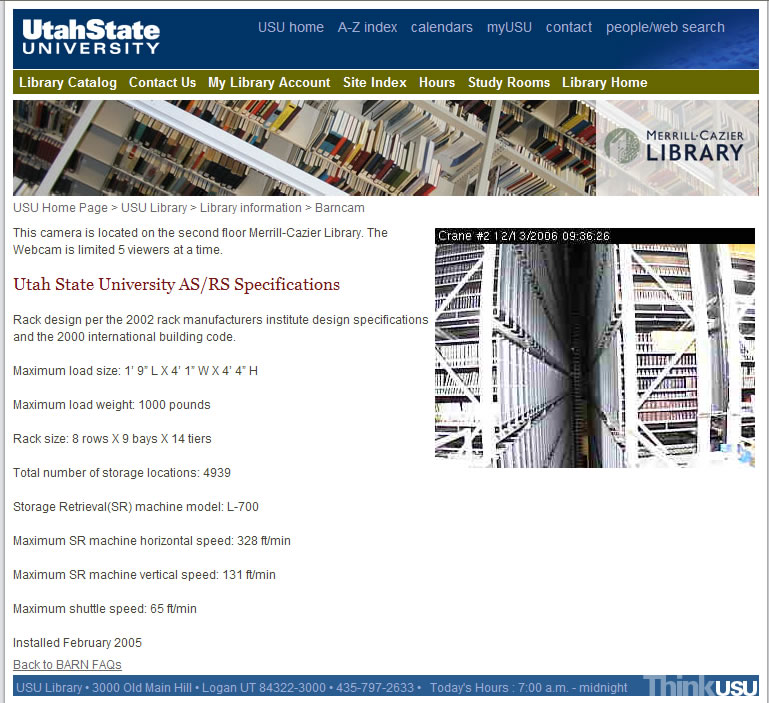
Unfortunately, the article made no further mention regarding exactly what books were housed within the USU Merrill-Cazier Library retrieval system, the BARN. Sharing my finding with two student workers, I wondered if it was the entire library or specific collections within the library utilizing the system. In all honesty, we were a bit taken aback by the idea of a juvenile collection being part of this storage since it is routinely a frequently browsed area in our library. I was intrigued enough to want to learn more. They were concerned I watched the availabe web cam to see how it worked. Check out the BARN (ASRS) page on the USU Merrill-Cazier library web site to learn about what the BARN is, why they chose a BARN, and what is housed in their BARN. For anyone wondering what BARN stands for, it means Borrower's Automated Retrieval Network; a much simpler, catchier acronym than ASRS or Automated Storage and Retrieval System.

With what may be a growing trend, how many institutions can actually afford this technology? I would imagine it is not something smaller and/or mid-sized academic libraries will quickly adopt. Not just because of the cost issue, but also because collections may not warrant off-site storage of any type. Either way, it sheds an interesting light on the shelf shifting I have been doing in the library juvenile collection for the last 4 - 6 weeks. Creating additional room where no room exists is an ongoing challenge, even an opportunity. In retrospect, a nice little robotic arm would have been welcomed.

Here are a few academic libraries in Canada and the US utilizing ASRS:

Tags: , , , , ,