Tuesday, January 09, 2007

Let's ChaCha

TechCrunch had an interesting post yesterday regarding a new search engine called ChaCha. This search engine works like a regular search engine and also provides and option to search with a guide. Yes, someone to chat with you while you search the Internet. A check of the search engine’s press page shows I am a bit late on the mark with this post as they debuted in September, but the premise is interesting.


Live help with searching is something libraries attempt via chat and instant messaging. OhioLINK's Chat with a Librarian service is a prime example of this endeavor. I have some experience using the OhioLINK Chat with a Librarian software and while it has improved significantly since its original debut, the software remains somewhat cumbersome. However, Chat with a Librarian does present opportunities during chat to push specific pages and a type of assisted search. It also offers something commercial search engines do not, an experienced librarian (without an agenda) to provide research assistance. I decided to try out ChaCha and see what type of results I could get.

I performed a ChaCha search, aka searching without a guide, for "library information science." After four tries, it timed out on the first three times, I got four pages of results. The first six were clearly marked sponsored, and four within the twenty first page returns were sponsored. Moving to the second page provided less sponsored links and slightly better information. Unfortunately, this indicates to me the quality of the returns is not particularly comprehensive as the results favor sponsors over searchers. The search screen provides a box of related search terms on the right that included links to library science schools, librarianship, library science graduate programs, Journal of Academic Librarianship, Library of Congress, library science degree, library science careers, and library professional journals. I would have linked to these terms, but ChaCha specifies you are only to link to their main page and not subsequent results Rounding out the page, displayed above the related searches, were quick links (ala Google) to Web, News, Images, Video, and Audio results for my initial Library Information Science Search.

I decided to try the same search using Search With Guide. It hooked up pretty quickly and I asked KarenB for information regarding schools that offer library and information science degrees. KarenB asked me if I wanted info information for schools in the US or the UK. I replied US and was transferred “to another guide who can help you search even better!” My second guide was Deboraha and I told her I had been transferred and was looking for library information science schools in the US. Five minutes later and I still do not have a response from Deboraha. In fact, she has not provided any information to me beyond her original canned message welcoming me to ChaCha and saying hello. After waiting a total of ten minutes, I cancelled the search and started again. I had an opportunity to rate Deboraha and her guided search; it was bad.


My second guide was TiaK. I was greeted with the same canned message, not a bad idea and one that OhioLINK Chat uses as well. I mentioned she was my third guide she asked about the first two. I gave a short synopsis and TiaK assured me she would find results more quickly. She did; it took her about three minutes to locate two results, one from the University of Illinois and the other from University of South Florida. When it took a bit longer, a bit of dead air space, I asked if she could target schools in Pennsylvania and Ohio. With this extra information, TiaK found ALA’s LIS Directory. The whole session took about seven minutes and without question TiaK got a better rating than Deboraha.

Naturally I became a bit curious about the guides and meandered through ChaCha’s site:

  • ChaCha’s privacy policy states:
"We value Guides greatly and they are essential to ChaCha, but they are not our employees. Guides are independent contractors, and we are not legally responsible for their actions."
  • ChaCha’s About Us page provides reasons for searching with a guide indicating:
    "By searching with a Guide your query is sent to a real person who is skilled at finding information on the internet and knowledgeable on the subject at hand so that you get the few exact results you want, not the millions of results you don't. ChaCha only provides quality, human approved results."
  • Also detailed within About Us is information regarding why users should trust their particular guide:

    "The primary reason is that we pay them and their pay is directly related to their performance. At the end of every session, you can select between one and five stars to rate their performance. While we expect you to be honest when rating a Guide, ChaCha can also detect any needlessly malicious ratings."

    "Another reason is that everybody knows a lot about something - ChaCha is able to connect you with the somebody who knows the something you want to know. Not only can they point you in the right direction, we've often found that communicating with a Guide can expand your general knowledge on the subject or even turn you on to new or different information that's even more relevant to what you're searching for."
Interested in becoming a guide? The posted qualifications are not all that stringent; in fact only seven criteria which include age (over 18), citizenship, spelling and English fluency, high speed internet, and ability to search the Internet are listed. Fortunately, Campus Technology reports there are further requirements of tests and questionnaires and a CNet article indicates there are different levels of guides "apprentice, pro, master, and elite" who will "earn reputations based on user ratings and how the system rates their performance" (CNet, 9/3/06) as the service progresses.

Overall I like the idea, but found the general search engine lacking. The guided search screen is user-friendly (wonder if they will market to libraries?), but the guides a bit frustrating. I would like to know more about who is doing the search and how they determine if the quality of results. I definitely do not like the sponsored links presented above others, but know that is how search engines make money.

Tags: , , , ,

Thursday, January 04, 2007

Libraries in the News

Wow this has been quite a week as the mainstream media has definitely been shining its spotlight on libraries and librarians. For librarianship as a profession the coverage has been favorable as the Wall Street Journal talked about our changing role which compliments the recognition given last month by the U.S. News & World Report naming it one of the 25 best careers of 2007.

Unfortunately, the news hasn't been so kind to all. The New York Times first reported on Tuesday about the Maplewood Memorial Library in New Jersey which has decided to close between 2:45-5pm due to crowds of Middle and High School students who hang out there after school until their parents pick them up after work. Apparently there have been multiple problems over the years with some misbehaving teens and the library feels that this is their only option at this time. The paper posted a follow-up piece today about the situation which indicates that the government in Maplewood seems to be trying to come up with alternative solutions.

Fairfax County Public Library has also sent the media into a tizzy with their new weeding program. It was reported on Tuesday in an article in the Washington Post and then lambasted in an opinion piece in the Wall Street Journal on Wednesday. Both pieces are quick to emphasize the elimination of "classics" for newer books. Due to the coverage, the library has posted a response on their website to help explain their position. I particularly recommend reading the responses to the Wall Street Journal piece as they represent the opinions of many members of the public. The issue of weeding has always been controversial when the public is involved, but it is also not without debate within the library profession. One response to this item worth reading (whether or not you agree) is at the Annoyed Librarian.

Tags: , , , ,

Confessions of a post label convert

I had no blogging plans today. I normally do not have that much to say. But I spent some time doing backup on the IRC blog, posted a DVD, and noticed the labels ...

Used mostly as an informational tool for collection development purchases, the IRC blog replaced not only my IRC "what's new" web page, but also numerous email notifications to faculty regarding said purchases (specific requests still get email). Furthermore, it saves me countless hours by not having to compile and post end of term book lists. But I digress. This morning I added a DVD, used the labels for this post option, and checked out the blog. Pleased, I went back and added labels to the most recent 50 posts. I viewed my efforts, clicked on the post links, and am now quite enamored with the post labels. My organizational librarian soul is hooked.

Why use these labels instead of Technorati or other tags? Because the IRC blog is basically an in-house tool, I do not particularly care if anyone outside of the AU community views it and nixed that tag option. I am not trying to increase readership from the blogosphere as it is not that kind of blog. If they find it (and people have done so), great. What I am interested in is making the blog more effective for my users/patrons. Since the post labels link within the blog, any post tagged "juvenile books" will link to all subsequent posts tagged the same. Each item within an individual post is displayed with its call number and linked to the catalog. The blog sidebar has a catalog search widget to facilitate locating other like titles or just searching from the blog. Now, the 50 most recent blog entries themselves are linked.

No, I'm not saying I will go back and tag all 370 posts remaining ...

(I just finished spell checking and it's pretty cool, highlighting the suspicious words and providing options on mouse-over.)

Tags: , ,

Wednesday, January 03, 2007

Looking good

The ACRLog has a new look for the New Near. Along with the new look are a few new features I particularly like are an events calendar for ACRL items and a link for story ideas, the ACRL Tip Page. It will be interesting to see how these changes help the blog to evolve. I'm not so sure I like the recent comments section, but as long as people take responsibility for what they are commenting it should be interesting. The ACRLog blog team is listening to its readers.

Today is day two of the "new" Blogger (it is not Blogger Beta any longer!) and I have yet to use many of the highly touted enhanced features. The drag and drop option template customization requires an upgrade to the existing template.


"We've introduced a new tool for customizing the appearance of your blog. Before you can use this tool, you'll need to upgrade your template. By upgrading, you will lose many of the changes you previously made to your template. However, we will save a copy of your current template so that you can access it later. " (How can I use new layout features, 1/3/07)

Yikes, lose changes made to the template? When the Blogger gods highlight this particular notification in red it gives me pause. I am curious to see how these features work, but plan to practice upgrading one of my lesser used blogs first. Plus, Library Cloud is a team blog and template changes will not be made until Rebecca and I have a chance to make that particular
determination.

In addition to the post label options discovered yesterday, among the several changes I noticed are the dashboard layout, photo upload, and ease of publishing. As of now, I am not overly thrilled with the new Blogger dashboard. It is nice to be able to choose post, setting, and view blog from the initial screen, but it is a bit cumbersome. Something interesting I noticed when adding my dashboard screen shot to this post is the new terms of service option you must agree to before blogger will upload any photo. One more thing on the definite plus side is how much quicker publishing is with new Blogger.

Tags: , , ,

Tuesday, January 02, 2007

"It's a puzzlement"

Yes, a quote from The King and I. It is one of my mother’s favorite musicals, a statement I always found intriguing, and an oddly appropriate title for this particular blog post conundrum. I did little professional reading, or writing for that matter, over the holiday break. However, I did find time to peruse (read scan and put aside for later reading) my December issue of American Libraries and found an opinion column by David Isaacson, “Don’t Just Read – Read Good Books,” that I agree with on one level and am oddly insulted by on another.

I agree with his argument that as librarians we should be promoting “good books” and have an obligation to provide books for our patrons that are not only award winning, but also critically acclaimed. Point of fact, this morning I selected several titles from Choice Reviews utilizing allocated librarian choice book funds and ordered several recommendations and/or requests from education professors. Both of these support collection development policy, purchasing quality publications supporting the education curriculum at AU. I have the latest edition of Booklist and School Library Journal precariously perched atop my “to do” pile waiting for juvenile collection development, a cart full of previously selected Teacher’s Choice and Children’s Choice award books requested by a children’s literature professor, and am awaiting selections on the Young Adult’s Choice titles from another children’s literature professor. All of these actions loosely ascribe to Isaacson’s opinion:

“We should want our patrons to read good books, and then better ones, and then, once curiosity is aroused, the best ones they can find. And although this sounds not only old-fashioned but “judgmental,” I think librarians ought to have the courage to say that some books aren’t worth reading at all and don’t belong even in the most “balanced” collections.” (AL, 12/06, p.43)

Yes! I want students to have and use a balanced juvenile and LC “L” collection. They need to see good books, great books, and banned books. They need to understand that just because the book is part of our collection; it does not mean an automatic stamp of approval for classroom use. It is the student, the preservice teacher, who makes a final decision when using books for lessons or recreational read-aloud in their classroom. Isaacson goes on to discuss what he terms “intellectual discrimination.” As an academic librarian, I agree in principle with his comments. AU library has a small recreational reading collection funded by our Friends of the Library organization and director has moved away from purchasing the typical recreational genre when adding to this collection. However, as a former public librarian and avid reader of the “other literature” discussed, I beg to disagree when this is applied to public libraries. Judge for yourself:

“But I question the argument that libraries should go out of their way to acquire romance novels, thrillers, and other literature whose primary purpose is escape and titillation. Why should we compete with bookstores for this market?” (AL, 12/06, p. 43)

Public library collections are for the public and funded by public tax dollars. If a patron wants the newest Nora Roberts or John Grisham title, he or she has the right to expect that their library has a copy. Yes, the librarian has an obligation to select critically acclaimed titles and readers have the right to expect good literature. I simply do not believe we have the right to look down upon those readers who want romance, thrillers, mysteries, graphic novels, and science fiction. Sure the local book store carries those titles in hard back and soft. But not every patron has the funds to purchase them for their personal library. That is why we have public libraries, to facilitate reading and readers of all books. Not just the books librarians think they should read.

Yes, my opinion on this matter could be termed biased. I am an avid recreational reader and very much enjoy the genres of romance (Nora Roberts, Jayne Ann Krentz, Jennifer Crusie, and Linda Howard), mystery and suspense (Jonathan Kellerman, Robert Parker, Janet Evanovich, and Lisa Scottoline), fantasy (J.K. Rowling), and historical fiction (John Jakes). As a reader I do not particularly appreciate being told these titles are not library worthy because they are beneath me in an intellectual literature sense. I also consider myself a discriminating reader who enjoys both literature and recreational reading. Now? Picture me stepping down from my soap box, but satisfied with the opinion expressed.


Tags: , , , , , ,

Addendum, What's with the labels? I switched over my AU blogs to the "new blogger" this afternoon and did not realize this one would go as well (apologies to Rebecca). As a result, there are now label options for each post that appear to work similarly to the Technorati tags Rebecca and I have already been using. I have been satisfied with the Technorati tags, but am willing to try the Blogger tags. I'm not sure how they work or where they will appear until I look at some of the "new" opportunites this version presents.

INFOhio flyers from OhioLINK

Once again OhioLINK (Ohio Library and Information Network) and INFOhio (The Information Network for Ohio Schools) are providing fliers to education librarians for distribution to their education faculty and student population. The fliers, Think INFOhio, detail "information to inform education faculty and students about the tools available to preservice teachers" and include many of the resources available to K-12 educators. Candi Clevenger, OhioLINK, and Cythia DuChane, INFOhio's Project Coordinator, provided additional links in the letter accompanying the fliers.
I have already placed my fliers in the handout rack outside of the IRC and encourage other education librarians to do the same. The resources available to teachers through INFOhio are exceptional.

Tags: , , , ,

Tuesday, December 19, 2006

Blog Holiday

The holiday's are fast upon us and, as with many blogger's on semesters, I will be taking a break from blogging until after the New Year. Until then, here are a few interesting tidbits and postings from a few of my favorite blogs:
  • ACRLog: Here's What You Told Us
    This post includes highlights from the recent ACRLog poll regarding readership. I found it interesting that many of the readers are new/newer librarians. "And ACRLog readers are mostly a group that is newer to academic librarianship as 52% reported being in the profession 5 years or less. Compare that to the 13% of readers in the profession more than 20 years. That’s an area where we can certainly achieve more balance."
  • ALA Techsource: Google goes to college
    I have a google email and account name and know there is much more I could be doing with the available resources. This post declares, "For librarians who spend much of their time liaising with faculty, this (Google apps for education) has the potential to revolutionize the way we interact with them."
  • Read Roger: For the Alias fans in Mourning
    Roger has been providing links and information regarding digital stories.
  • TechLearning Blog: The future of Academic Publishing
    Somthing of interest to many academic librarians the author takes a look at academic publishing as a whole.
  • Walt at Random: Book Publishing in the U.S., Bigger than we thought?
    Great statistics and information regarding "the book." After standing in line at Borders two evenings ago, I'd say the book is in pretty good shape.

Merry Christmas, Happy New Year, and peace to all.

Tags: , Blog Holiday

Wednesday, December 13, 2006

BARN's and ASRS

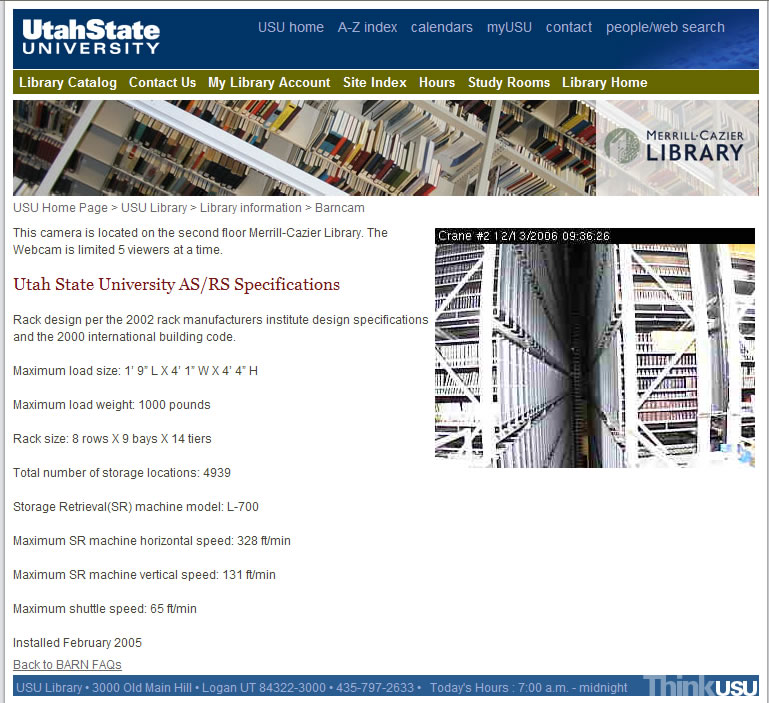
This morning I have been perusing the growing stack of journals on my desk, passing on one's I have read to other librarians and putting others aside for further reading. In addition to general library fare that includes Booklist, Book Links, and Library Journal, I began browsing through the year end special issue of Campus Technology that features "101 Best Practices in ... Smart Classrooms, Connectivity, and Administrative IT," December 2006. Paying particular interest to this issue because recently I began serving on a technology instructor search committee for the College of Education, I was intrigued to find buried amongst emerging classroom technologies (check out Tegrity) a Smart Library at Utah State University with the Smart Classroom section.

"Utah State University’s new Merrill-Cazier Library, opened in the 2005-2006 academic year, is using technology to not only retrieve information from the library catalog, but also retrieve the books themselves. The $42 million project features a state-of-the-art system of robotic stacks, 85 feet high, 60 feet wide, and 120 feet long, which locates requested materials among the 1.5 million volumes and speeds them to patrons—at a rate of 328 feet per minute. The space-saving system allows for many years of collection development. Says Linda Wolcott, vice provost for libraries, “The Merrill-Cazier Library has become the hub of learning on campus, providing the resources, access to technology, and flexible study environments that support the way students learn today.” " (Smart Library, Campus Technology, 12/2006)


Unfortunately, the article made no further mention regarding exactly what books were housed within the USU Merrill-Cazier Library retrieval system, the BARN. Sharing my finding with two student workers, I wondered if it was the entire library or specific collections within the library utilizing the system. In all honesty, we were a bit taken aback by the idea of a juvenile collection being part of this storage since it is routinely a frequently browsed area in our library. I was intrigued enough to want to learn more. They were concerned I watched the availabe web cam to see how it worked. Check out the BARN (ASRS) page on the USU Merrill-Cazier library web site to learn about what the BARN is, why they chose a BARN, and what is housed in their BARN. For anyone wondering what BARN stands for, it means Borrower's Automated Retrieval Network; a much simpler, catchier acronym than ASRS or Automated Storage and Retrieval System.

With what may be a growing trend, how many institutions can actually afford this technology? I would imagine it is not something smaller and/or mid-sized academic libraries will quickly adopt. Not just because of the cost issue, but also because collections may not warrant off-site storage of any type. Either way, it sheds an interesting light on the shelf shifting I have been doing in the library juvenile collection for the last 4 - 6 weeks. Creating additional room where no room exists is an ongoing challenge, even an opportunity. In retrospect, a nice little robotic arm would have been welcomed.

Here are a few academic libraries in Canada and the US utilizing ASRS:

Tags: , , , , ,

Tuesday, December 12, 2006

A bit of finals week library humor

Flush with the successful completion of the term without major technology failures, only one dead computer for a single 24 hour period, or horrific equipment failures, a new plug on our roll top laminator not withstanding, we have begun finals week at Ashland University. The library and IRC undergo another interesting metamorphosis regarding library as a place.

As previously mentioned, last Friday was the due date for 131/504. It is not an exaggeration to say students in the IRC were lined up five deep to make Ellison letters (we have 6 machines), muttering about the time it was taking to pick up print jobs (someone printed a 150 page article during a particularly busy time), and the table by the binder was full as students waited their turn to bind their final portfolio project. The noise level on the second floor was higher as discussion ensued regarding the best way to finish quickly. No one was exceptionally loud, everyone was using their "inside voices," but there was a constant muted conversational buzz throughout the day. During this time, no one mistakes the second floor of the library for quiet space. Not so during finals week.

Yesterday every computer, study table, and miscellaneous available work space on the second floor was occupied by students studying. The quiet, a definite contrast from last week, was almost deafening. In the midst of the quiet came a first for the IRC. On my way to lunch and then a technology search committee meeting at the College of Education, I was chatting with two student workers (I think dolls for toddlers might have been our subject) when a very polite young man came asked if he could shut the IRC door.

I was chagrined to realize that indeed we were the noisiest people in the IRC!

Tags: , , ,

Tuesday, December 05, 2006

Who's Who? What do you think?

Along with several thousand other people, I received a letter from Cambridge Who's Who in late October (the 25th to be exact) informing me I was "being considered for inclusion into the 2006/2007 Cambridge Who's Who Among Executive and Professional Women in Education 'honors Edition' of the Registry." After dragging it from my mail box, I covertly glanced to see how many others received the same missive. The letter further explained:


"The 2006/2007 edition of the Registry will include biographies of our country's most accomplished women. Recognition of this kind is an honor shared by thousands of executive and professional women throughout America each year. Inclusion is considered by many as the single highest mark of achievement.
Upon final confirmation, you will be listed among thousands of accomplished women in the Cambridge Who's Who Registry.
For accuracy and publication deadlines please return to us your application form within five business days from the receipt of this letter. There is no cost to be included."

It sat on my desk for several days and on a whim, I sent it back and did not think anything more about it. Until today. This afternoon I got a phone call from Cambridge Who's Who and after a short question and answer period I was congratulated and told my biography was accepted.
At that point the sales pitch commenced.
The price for being included in this edition ranged from $189 - $700 depending on the level of sponsorship (for want of a better word) I was prepared to purchase. I had no desire to make this decision spur of the moment and the longer I "waffled," the harder the push. At one point I was asked, "Don't you know who we are?" That was when my patience expired. I replied, "Yes, but I have no intention of making a purchase of this magnitude over the phone without any consideration." She relented and gave me until 5:30 pm this afternoon to decide.
Naturally, I began my research on this company after lunch. I started with my boss, who had never heard of them, and finished with a quick Google search. Findings ranged from a few happy consumers to snarky reports of outright scam. I also found several mentions of this letter in other blogs.
Negative research results:
Positive customer results:
Blogging about the directory:
An interesting discovery:
I was less than thrilled with the sales pitch, mostly because the representative was pushy and rude. (It is now 5:30 pm and I have missed her deadline.) The crux of the matter for me? If it costs nothing to be included, why must I pay for a subscription and/or join? I would be interested in hearing comments from others who have paid for this service and/or opted out.
Update: 12/12/06
Last Friday afternoon I received a second call from Rebecca at Cambridge Who's Who. I freely admit I did not expect to hear from the company after missing my deadline earlier in the week. However, when she started the entire sales pitch a second time, including wanting to ask me additional questions to further assess my qualifications for inclusion, I politely interrupted and told her we had this conversation last week. I also reminded her I had answered all of the secondary questions and that she already welcomed me to the "family" (so to speak).
I questioned why I was being asked to make a purchase when the invitation letter specifically noted "There is no cost to be included." The clearest part of her circular answer detailed benefits only offered customers subscribing to their registry. I declined the opportunity to make a purchase and admit to some curiosity regarding my inclusion in the upcoming registry. It is obvious I should have researched before sending in the application, but I was flattered, somewhat naive, and did not see the harm. Quite honestly, no harm no foul for the entire process because I have learned something.

Tags: , , ,

ACRLog Survey

To celebrate their first year in existence, ACRLog is conducting a readers survey. As of this morning there is still time to participate. If you are a regular reader of ACRLog, or are simply interested in learning more about it, now is a good time to see what they are doing and make suggestions for topics.

Tags: , , ,