Monday, June 02, 2014

ALAO 2014: Call for Proposals Extended

The submission deadline for full-length sessions
has been extended to June 9, 2014.


The Academic Library Association of Ohio (ALAO) Conference Planning Committee invites you to submit proposals for the 40th Annual Conference, which will take place on November 13-14, 2014 at the Kalahari Resort & Convention Center in Sandusky, OH.

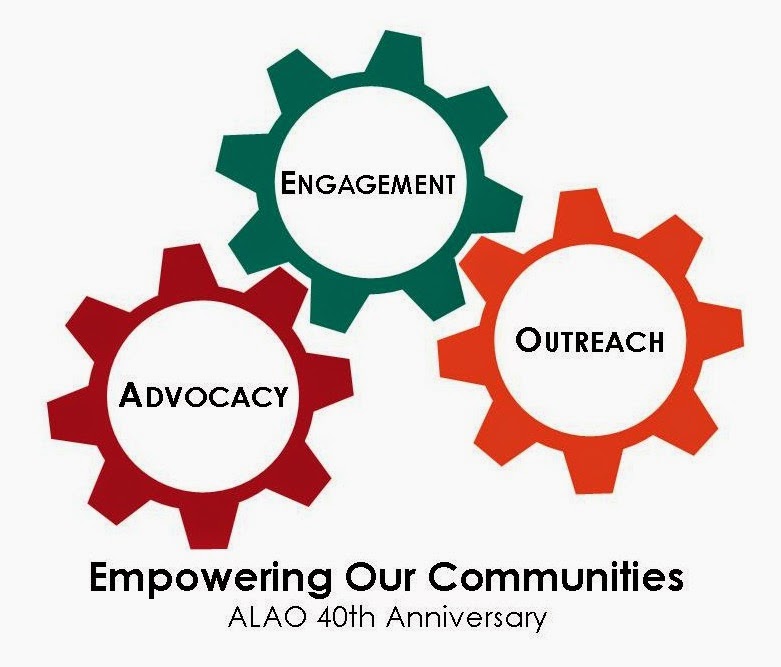
Presentations may take the form of contributed papers, demonstrations, workshops, research results, panel discussions, etc. Applicants are encouraged to develop sessions that show thoughtful consideration of this year’s conference theme, “Engagement, advocacy and outreach: Empowering our communities,” which seeks to explore how academic libraries and librarians empower our communities in all the ways that we do. We would love to learn about your ideas, experiences, solutions, and best practices – even those that yielded results that were different than expected!

Submit your proposal online @ http://bit.ly/alaocall14


Presenter grants ALAO encourages library support staff and library student growth, career development, and participation in conference activities, and awards two presenter grants, one for support staff and the other for students. These grants (up to $150 each) are intended to assist with the costs incurred in preparing the presentation and modest travel costs associated with the presentation. Visit the conference web site for additional information.

Please note that only presenters of full-length sessions and posters selected for inclusion in the conference will be eligible for final consideration for the grant.

*posted to ALAO List 5/30/14

Friday, May 23, 2014

Weekly Reader

Technology, Learning, and Institutional Mission Statements
"Right now I’m preparing for a talk I’m giving next month, in which I’ll be speaking on using technology to connect students, faculty and institutions to the fundamentally human activities of learning and growth. Of those three groups – students, faculty, and institutions – I’m finding it to be a lot easier to talk about students and faculty and their relationship to technology than it is to talk about institutions. I’m wondering: Why is that?" -- Robert Talbert, Casting Out the Nines | The Chronicle, 5/19/14

Pinterest's New "Question" Feature Might Be the Key to Visual Search
"Pinterest is testing an unnamed Q&A feature, the visual search company confirmed to ReadWrite.The feature came to light after developer Tom Waddington blogged about noticing a blank “Questions” tab on his Pinterest account for Cut Out & Keep, a craft community he helped found in 2007. A quick scroll through the code indicated the feature was almost ready to be rolled out. When I reached out to Pinterest, a spokesperson confirmed that it wasn't a coincidence." -- Lauren Orsini, ReadWrite, 5/15/14

Monday, May 19, 2014

ALAO 2014: Submit a Proposal

Interested in submitting a proposal for the Academic Library Association of Ohio's (ALAO) annual conference but not sure where to begin? The following information is part of the online submission form; it may help prepare the required proposal descriptions (brief 50, long 150). Additional presenter resources are available on the conference web; included are links for first time presenters and proposal descriptions from previous conference programs.

Presentations may take the form of contributed papers, demonstrations, workshops, research, or panel discussions.  You are welcome to submit multiple proposals, however no more than two will be accepted for inclusion in the conference program.  All proposals must be submitted using the online form.


The call for proposals submission deadline is May 30th.

If you are interested in poster sessions, a second call for proposal will be available in late June for posters, lightning talks, and round table discussions.


Be prepared to submit your proposal:
  • A title and brief description: 50 words maximum. 
  • A long description: 150 words maximum. 
  • DO NOT include identifying information in your proposal submission. 
  • Consider how your presentation will connect with the audience.
  • Sessions will be 50 minutes in length including time for Q & A.

Guidelines for submissions:
  • Proposals are blind-reviewed. 
  • Content, relevance to conference theme, & overall appeal are key. 
  • Proposals should be concise, descriptive, and clearly written. 
  • Submissions containing identifying information may be disqualified.

Guidelines for the online submission form:
  • Be sure to complete ALL of the required information. 
  • It is possible to move between sections of the form.
  • It is NOT possible to save work in progress.
  • EMAIL confirmation from alao.cpc at gmail.com will be sent to the lead presenter for each submission.

If accepted to present at the ALAO 2014 Conference:
  • Presenters are responsible for their own conference registration.
  • Presenters are responsible for all travel costs. 
  • Presenters will provide a presentation link or electronic copy. 
  • Presentations will be archived on the ALAO web site for three years. 
  • Technology and / AV requirements will be communicated. 
  • Tech help will be available from the CPC Technology team.

Friday, May 16, 2014

Weekly Reader

Surprise! Your Personal Data is Not So Personal
"You can be forgiven for believing that your personal data is actually yours. After all, it's your email. Your Fitbit. Your GPS device. Or your tractor. The reality of today's data-obsessed world, however, is that the minute your data hits the cloud, it's no longer yours. Not even remotely." -- Matt Asay, ReadWrite, 5/12/14

Lurkers Are the 99.989% of Social Media
"Sam Fiorella, Partner at Sensei Marketing, recently wrote “Community Management: The 90-9-1 Rule is Dead,” about the old concept that 90% of all your followers are just lurking, 9% are engaged, and that only 1% of the community actively produces content. Sam believes this is dead and that it’s closer to 70%/20%/10%, according to some research by Paul Schneider (from back in August of 2011). I don’t know if I agree with this — I think it’s more like 990-9-1 — we’ve attained a culture that is getting further and further from being an actor and more and more comfortable in the audience." -- Chris Abraham, Social Media Today, 5/12/14

2014 Summer Reading Recommendations
"Educationalists will tell you how important it is for children to keep reading throughout the long summer break lest their ever-evolving literacy skills erode. Fine. That does not, however, excuse the frequently dreadful list of recommended or — eep — required reading that schools shoot out as one last salvo of homework just as everybody is looking forward to a nice break." -- The Horn Book, Choosing Books, 5/12/14

Failing Faster: Reflecting on Making a Game a Week
"At the beginning of March, I began an adventure in making a game a week with a cohort of fellow scholars and designers (Mark Danger Chen, Melissa Peterson, Dennis Ramirez, and Greg Koeser) looking to increase their creative practice and experiment. It’s now two months later, and I’ve mostly been faithful to the pledge (sans one week of end-of-term madness, my only full failure)."-- Anastasia Salter, ProfHacker, 5/12/14

Is Rereading the Material a Good Study Strategy?
"Lots of good writing on the science of learning is coming out now and it’s needed. For too long we have known too little about learning—I won’t digress into the reasons why. We need to take advantage of this opportunity to learn more about this science." -- Maryellen Weimer, The Teaching Professor Blog, 5/14/14

JOI to the Library
"'This might be too geeky for a column,” said the subject line of a reader's email, “but just in case …” It sounded like a challenge, and I took the bait. The topic in question? A new statistical instrument to quantify the degree of open access for scholarly journals. In other words, exactly geeky enough." -- Scott McLemee, Intellectual Affairs, 5/14/14

Tuesday, May 13, 2014

Meanwhile, on Pinterest

With the notable exception of the Library Memes and Library Book Fun boards, when curating pins for the IRC Pinterest site I commonly upload my own content or pin directly from a site that features 'pin it' buttons for content. If re-pinning, I try to go back to the original site and check before opting to pin. Hence, it was a bit startling to receive an email from Pinterest with the subject line, "Sorry we had to delete one of your pins on Pinterest."

We're getting in touch to let you know we received a copyright complaint and have removed one (or more) of your Pins. The complaint wasn't directed against you or your Pin; it was directed against another user's Pin of the same content.

While many copyright owners are happy to have their content on Pinterest, we recognize that some do not want their content to appear on Pinterest, or did not receive attribution for the content. When a copyright owner sends us a complete notice per the Digital Millennium Copyright Act (DMCA), it’s our policy to remove the Pin(s).


Again, this complaint was not directed at you, or anything you did: we just thought you'd like to know why we removed your Pin.


Happy Pinning and thanks again for using Pinterest.

Wait. What?

After the initial shock (and dismay), I admit being pleased to learn Pinterest is taking these steps when images and items pinned are problematic and/or violate copyright. While I do not know particulars such as how long it took for the image to be removed, how long or how often the copyright owner had to complain, or how many sites had pinned the image (it was cute), the end result works.  I will be keeping the email and sharing it with students in my online class during our Pinterest module.

Monday, May 12, 2014

Spring Cleaning: Summer Floor Moves

One of the more challenging aspects of a finite library space, in my case the second floor and IRC, is collection presentation and placement.  Generally speaking, for several years a few shelves in sections have made the process somewhat simpler; shifting things when there is room is time consuming, but manageable. More often than not, floor moves and collection reorganization are made to the juvenile collection (high circulation and use) and IRC materials and equipment (technology and Ellison).

For example, during the late fall 2012 and early spring 2013 academic year a library video weeding project, evaluation of second floor collections, and reorganization of library department office space resulted in two significantly sized second floor collections being relocated to the library ground floor. Space - glorious space was now available and it was necessary to proceed with caution and purpose.

I drafted a rough floor layout and charted remaining collection space, existing open sections, and potential moves. Detailed within the chart and layout was need for existing collections and the total number of sections, shelves, and stacks. Collections were weeded (the chart updated), placement and need evaluated, and additional criteria such as student use and access were considered.  The result? With the exception of LC Ls, every collection housed on the second floor and inside the IRC was moved. Some had their overall footprint expanded,  several new collection areas were created (over-sized juvenile books), and a listening room was converted to a study room. After eliminating a section of shelving to facilitate traffic flow and access, I had a full row of empty shelving consisting of eleven sections with the potential of six shelves each.

Flush with success, I decided to let 'the dust settle' and the shelving remained empty during summer and fall 2013. It is easy to get caught up in the excitement of the moves when the end result is a more attractive and usable area. Collection movement created energy and interest in the affected areas. Generally speaking, collections removed from the second floor were not missed. However, changes to the juvenile collection, even with the end result providing more space, caused some user angst.  Signage was updated, the IRC Pinterest site provided pictures of the move, and a much needed overhaul for the IRC Handbook began.

The never-ending winter, also known as the spring 2014 term,  provided opportunity to make a number of quick collection and space adjustments necessary to facilitate my planned summer juvenile collection project (in conjunction with migration to LibGuides v2, but that's another blog post or two).  In order to increase space for activity books, the IRC curriculum textbook collection was weeded, updated, and shifted to the open shelving near the LC Ls. Big books, book kits, and award books were moved to the open curriculum space. After purchasing two new media racks, the big book area was expanded. Big book stands were moved from inside the IRC with materials kits to shelving adjacent to the big book collection. I was exciting to add new big books and book kits too the IRC and juvenile collections.

Now the aforementioned sections of empty shelving are positioned at the end of the juvenile collection ... exactly where I need them to be.

Friday, May 02, 2014

Weekly Reader

Why #NetNeutrality Matters to Higher Ed
"If you work in the digital humanities–or for that matter, in higher education–net neutrality is an issue that calls for a concerted response from all of us now. if you’re still getting caught up, check out Adeline’s post on this from last week, Alexis Madrigal’s guide to the history of Net Neutrality, and Colorlines on why people of color need to care about this." -- Adeline Koh, ProfHacker / The Chronicle, 4/29/14

Google Disables Scanning of Student Emails for Advertising Purposes
"Under pressure from privacy advocates, Google announced on Wednesday that it had permanently removed all ads from its Apps for Education, including its email service, so the company can no longer harvest students’ information for advertising purposes." -- Steve Kolowich, Wired Campus,  4/30/14

Do You Want to, or Have to, Give that Speech?
"When I created my popular checklist for the whole speaker a few years ago, I started the list with questions about your intentions as a speaker, mainly to help you consider whether you're approaching the talk or presentation with your audience in mind. Since then, however, I've met some speakers for whom intent isn't always part of the picture." -- Denise Graveline, The Eloquant Woman, 4/30/14

Snapchat: A New Breed of Network
"Social media continues to evolve at a furious pace, and Snapchat sits at the intersection of an ongoing debate about the nature of social. Must networks be long-term repositories of messages and media, or can some be vehicles for sharing information for a short time?" -- Derek Smith, Social Media Today, 4/30/13

Students Push for More Access to Course Evaluation Data
"For decades, faculty members and administrators have erected walls around the data collected from students’ course evaluations, concerned about how the fickle tastes of undergraduates might affect promotion prospects. Now, though, students are increasingly accustomed to browsing consumer reviews to make informed choices. As they bear the weight of rising tuition, many students are growing frustrated by their colleges’ secrecy and are pushing to dismantle those barriers." -- Benjamin Mueller, The Chronicle / Faculty, 4/28/14

Monday, April 28, 2014

Call for Proposals: ALAO Conference 2014

2014 ALAO Conference
The Academic Library Association of Ohio (ALAO) Conference Planning Committee invites you to submit proposals for the 40th Annual Conference, which will take place on November 13-14, 2014 at the Kalahari Resort & Convention Center in Sandusky, OH. The submission deadline for full-length sessions is May 30, 2014. Applicants are encouraged to develop sessions that show thoughtful consideration of this year’s conference theme, “Engagement, advocacy and outreach: Empowering our communities,” which seeks to explore how academic libraries and librarians empower our communities in all the ways that we do. We would love to learn about your ideas, experiences, solutions, and best practices – even those that yielded results that were different than expected!

Presentations may take the form of contributed papers, demonstrations, workshops, research results, panel discussions, etc. Topics may include, but are not limited to:

Engagement
  • Library contributions to student retention and success 
  • Rethinking our work and services to meet the needs of our communities
  • Using spaces, exhibits, displays, and/or social media to engage users in new ways
  • Creating innovative librarian/faculty partnerships in support of curricular initiatives

Advocacy

  • Partnering with stake-holders and decision-makers to develop effective messages regarding library value
  • Using data to inform academic library advocacy efforts
  • Influencing higher education policy and legislation at local, state, and national levels

Outreach

  • Collaborating with community and institutional partners
  • Reaching special student populations (veterans, international students, distance learners, etc.)
  • Programs and initiatives that have worked (or not!)

You may submit multiple proposals, however, no more than two will be included in the final program. Proposals are blind-reviewed for content, relevance to the conference theme, and overall appeal.

  • Submit your proposal online.
  • A concise, clearly written description and abstract will help the reviewers in evaluating your proposal.
  • Need help? See our presentation guidelines web page for tips.
  • Exclude the name of your institution, department and any personal names in the abstract to expedite the blind review process. You do not need to exclude this information in the brief description.
  • Presenters will be contacted regarding your AV/technology requirements when your proposal is accepted.
  • All presenters are responsible for their own registration and travel costs.
  • The conference planning committee recommends you print a copy of the completed form for your records before submitting.
  • Email confirmation from alao.cpc at gmail.com will be sent to each presenter - or lead presenter - upon successful proposal submission.
  • If you do not receive confirmation, or have questions about your submission, please contact Diane Schrecker (Ashland University Library) via email: alao.cpc at gmail.com.

ALAO encourages library support staff and library student growth, career development, and participation in conference activities, and awards two presenter grants, one for support staff and the other for students. These grants (up to $150 each) are intended to assist with the costs incurred in preparing the presentation and modest travel costs associated with the presentation. Please note that only presenters of full-length sessions and posters selected for inclusion in the conference will be eligible for final consideration for the grant.

Additional information is available on the ALAO 2014 Conference website.

Friday, April 25, 2014

Weekly Reader

From NASCAR Slides to "Any Questions?": 8 Kinds of Slides to Delete Right Now
"Lately, I've been coaching several speakers getting ready for industry conferences--hired either by their companies, or the conference organizers. As a result, I've spent an enormous amount of time telling speakers to ditch slide after slide after slide." -- Denise Graveline, The Eloquent Woman, 4/23/14

As Researchers Turn to Google, Libraries Navigate the Messy World of Discovery Tools
"Many professors and students gravitate to Google as a gateway to research. Libraries want to offer them a comparably simple and broad experience for searching academic content. As a result, a major change is under way in how libraries organize information. Instead of bewildering users with a bevy of specialized databases—books here, articles there—many libraries are bulldozing their digital silos. They now offer one-stop search boxes that comb entire collections, Google style." -- Marc Parry, Technology: Chronicle, 4/21/14

Multimedia Assignments: Not Just for Film Majors Anymore
"Millennials are often called "digital natives" because their familiarity with new technology seems to be in their DNA. Whether we like it or not, the "screen age" is here to stay—and with it has come a much more media-rich information ecosystem. Students are exposed to thousands of images a day. They share their own visual content via social-networking sites on their mobile devices, and orchestrate their own daily soundtracks with a portable music player and headphones. Yet too often their scholastic output more closely resembles that of their parents’ generation: a series of written words on a page." -- Danny Ledonne, The Digital Campus, 4/21/14

Confronting the Myth of the 'Digital Native'
"When Kaitlin Jennrich first walked into her communications seminar last fall, she had no idea that the professor already knew of her affinity for pink cars and Olive Garden breadsticks­—and that she planned to share that knowledge with the class. It hadn’t taken much sleuthing on the professor’s part to uncover those inane nuggets. The 18-year-old freshman at Northwestern University had herself lobbed them into the public sphere, via Twitter." -- Megan O'Neil, The Digital Campus, 4/21/14

Friday, April 11, 2014

Weekly Reader (part 2)

The Heartbleed Hit List: The Passwords You Need to Change Right Now
"An encryption flaw called the Heartbleed bug is already being called one of the biggest security threats the Internet has ever seen. The bug has affected many popular websites and services — ones you might use every day, like Gmail and Facebook — and could have quietly exposed your sensitive account information (such as passwords and credit card numbers) over the past two years." -- Mashable Team, Mashable, 4/11/14

The 'Heartbleed' Bug and How Internet Users Can Protect Themselves
"Security professionals working in higher education are updating servers, reissuing certificates used to guarantee secure Internet transactions, and encouraging students and faculty and staff members to take a break from the commercial Internet following the discovery of a programming flaw in a widely used Internet tool." -- Megan O'Neil, Wired Campus, 4/11/14

A Gentle Reminder About Security
"There are a lot of benefits to doing much of our work online. Collaboration with far-away colleagues is easy, we can have ready access to our work no matter what device we’re using, and having our work backed up in the cloud can be reassuring." -- Amy Cavender, ProfHacker, 4/10/14

How to Protect Yourself from the Heartbleed Bug
"A major new security vulnerability dubbed Heartbleed was disclosed Monday night with severe implications for the entire Web. The bug can scrape a server's memory, where sensitive user data is stored, including private data such as usernames, passwords, and credit card numbers." - Richard Nieva, CNet, 4/8/14

LastPass Heartbleed Checker
"With news breaking on Monday, April 7th that the Heartbleed bug causes a vulnerability in the OpenSSL cryptographic library, which is used by roughly two-thirds of all websites on the Internet, we want to update our community on how this bug may have impacted LastPass and clarify the actions we're taking to protect our customers. LastPass recommends everyone with a Yahoo.com account, OkCupid.com or Github.com account changes their password." -- LastPass, 4/11/14 [accessed]

Heartbleed: Serious OpenSSL Zero Day Vulnerability Revealed
"New security holes are always showing up. The latest one, the so-called Heartbleed Bug in the OpenSSL cryptographic library, is an especially bad one. heartbleedHeartbleed OpenSSL zero-day vulnerability. While Heartbleed only affects OpenSSL's 1.0.1 and the 1.0.2-beta release, 1.01 is already broadly deployed. Since Secure-Socket Layer (SSL) and Transport Layer Security (TLS) are at the heart of Internet security, this security hole is serious." -- Steven J. Vaughan-Nichols, ZDNet, 4/7/14

Wednesday, April 09, 2014

Weekly Reader

The Problem is Not the Students
"Last week I posted what I considered to be an innocuous and mildly interesting post about a proposed formal definition of flipped learning. I figured it would generate a few retweets and start some conversations. Instead, it spawned one of the longest comment threads we’ve had around here in a while – probably the longest if you mod out all the Khan Academy posts." -- Robert Talbert, Casting Out Nines | Chronicle Blog, 4/8/14

How to Run a Group Authored Blog
"Independently of each other, a small number of people have recently asked about the workflow involved in publishing a group-authored blog like ProfHacker. Now I don’t pretend that the way we do things is the best way possible, but I’m happy to describe how we go about publishing 2 posts a day, 5 days a week. If you’re involved in a similar project that uses a different workflow, feel free to share the details in the comments to this post." -- George Williams, ProfHacker Blog, 4/3/14

Toward a Common Definition of Flipped Learning
"We’ve seen a significant ramping up of interest in – and exposure to – the flipped/inverted classroom over the last few years, and it’s been nice to see an uptick in the amount of research being done into its effectiveness. But one thing that’s been lacking has been a consensus on what the flipped classroom actually is." -- Robert Talbert, Casting Out Nines | Chronicle Blog, 4/1/14

Love on Ice: What Tonya Harding Teaches Us About the Academy
"I’m not much for proxy wars among nation-states or for feats of heroic athleticism, so the Winter Olympics largely escaped my notice—except for one thing. At the moment, we’re avidly revisiting a range of cultural phenomena on their 20th anniversaries (right now, for example, Gary Sinise is on my television, talking about playing Lieutenant Dan in Forrest Gump). And at the intersection of nostalgia and Olympic fever, much attention has been given to an anniversary of dubious distinction: the 1994 U.S. Figure Skating Championships." --Jacqui Shine, Chronicle Vitae, 3/31/14

Campus Stung By Controversial Video Moves to Ban Recordings in Class
"The Faculty Senate of the University of Wisconsin at Whitewater has responded to a controversy over a surreptitiously obtained classroom video of a guest lecturer lambasting Republicans by moving to bar students from recording and disseminating such footage." -- Peter Schmidt, Faculty | The Chronicle, 3/28/14

6 Scaffolding Strategies to Use with Your Students
"What's the opposite of scaffolding a lesson? It would be saying to students something like, "Read this nine-page science article, write a detailed essay on the topic it explores, and turn it in by Wednesday." Yikes -- no safety net, no parachute, no scaffolding -- just left blowing in the wind."-- Rebecca Alder, Teacher Leadership Blog | Edutopia, 1/24/14